The Carriers You Have Never Heard Of: How Regional Couriers Are Outdelivering the National Giants
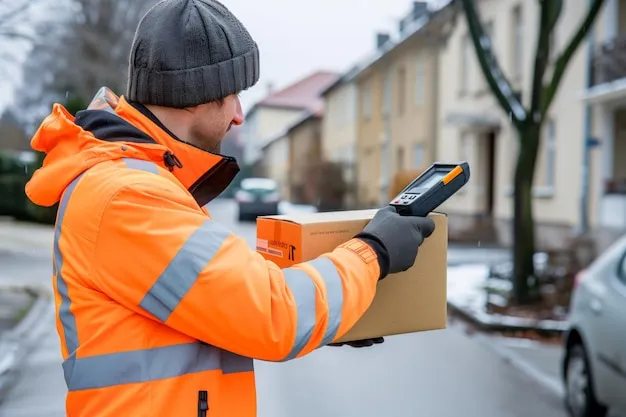
Photo: regional delivery courier driver scanning package small van neighborhood, via img.freepik.com
Ask most US shipping managers to name their primary carriers, and the answers are predictable. FedEx. UPS. USPS for certain volume tiers. Perhaps Amazon Logistics for businesses with that integration. The national networks are enormous, deeply embedded in procurement relationships, and supported by tracking infrastructures that took decades and billions of dollars to build.
And yet, across a growing range of industries and geographies, smaller regional and specialized couriers are winning business—and more importantly, winning on the metrics that actually matter to shippers and their customers. Delivery reliability. Accurate estimated arrival windows. Tracking data that reflects what is actually happening to a shipment rather than what an automated system assumes is happening.
Understanding why requires a closer look at what the national carriers' scale actually costs in terms of operational precision, and what the regional players' constraints have forced them to develop instead.
The Scale Paradox in National Carrier Tracking
The major national carriers built their tracking systems to handle extraordinary volume. On peak days during the holiday shipping season, UPS and FedEx collectively move tens of millions of packages through networks spanning thousands of facilities, hundreds of thousands of employees, and routing algorithms of immense complexity.
That scale is genuinely impressive. It is also, from a tracking accuracy standpoint, a liability in specific operational contexts. When a package enters a high-volume sortation hub during a surge period, the gap between when a scan occurs and when that scan is recorded and transmitted to a customer-facing system can stretch into hours. Status updates that read as real-time are frequently reflecting conditions that existed earlier in the day. The "out for delivery" notification that arrives at 7:00 a.m. was often generated based on a vehicle load scan that took place at 4:00 a.m.—before traffic patterns, route changes, or delivery exceptions altered the actual sequence of events.
For standard residential e-commerce deliveries, this lag is often inconsequential. For businesses shipping time-sensitive, high-value, or regulated goods, it is a meaningful operational problem.
Where Regional Carriers Have Found Their Advantage
The regional courier market in the United States is more substantial than its visibility in mainstream logistics coverage would suggest. Companies like OnTrac in the western states, LSO in Texas and the South, and a constellation of regional last-mile specialists have built networks that, within their geographic footprints, consistently outperform national benchmarks on delivery reliability and tracking accuracy.
Their advantages are structural. A regional carrier operating within a defined geography runs fewer packages through each facility, employs drivers who know specific neighborhoods and delivery zones with genuine familiarity, and maintains customer relationships that national account managers cannot replicate from a centralized sales office.
The tracking infrastructure these carriers deploy is often less technologically elaborate than what the nationals offer. Fewer scan events. Simpler customer-facing interfaces. Less integration with third-party logistics platforms. What their tracking data lacks in granularity, however, it frequently makes up for in accuracy. A regional carrier whose driver scans a package as "out for delivery" has typically just loaded that specific vehicle, in that specific geography, for that specific route. The status means what it says.
Specialized Couriers and the Vertical Advantage
Beyond regional generalists, a distinct category of specialized couriers has emerged to serve industries where standard carrier practices are structurally inadequate.
In food and grocery delivery, companies like Dropoff and Skipcart have built same-day and scheduled courier networks that integrate temperature monitoring, chain-of-custody documentation, and delivery confirmation into a purpose-built operational model. Their tracking data is designed for the specific regulatory and quality-assurance requirements of perishable goods logistics—something a national carrier's general-purpose tracking platform was never engineered to support.
In pharmaceutical distribution, specialized couriers serving hospital networks and specialty pharmacies have developed tracking capabilities that include real-time temperature excursion alerts, pharmacist signature capture, and compliance documentation—all within delivery windows that national carriers cannot reliably guarantee for this category of shipment.
In e-commerce returns, a growing cohort of specialized reverse logistics carriers has built tracking systems oriented around the return journey rather than the outbound one, providing retailers with visibility into return condition assessment and restocking timelines that standard carrier tracking simply does not address.
What Their Tracking Practices Reveal About US Logistics
The rise of these regional and specialized carriers is not merely a market share story. It is a signal about where the national carriers' model is generating friction—and what shippers increasingly value over raw network scale.
The most instructive pattern is the relationship between tracking honesty and delivery performance. Regional carriers that provide fewer status updates but more accurate ones tend to generate lower customer complaint rates than national carriers providing high-frequency updates with meaningful lag. The implication is that customers—and the businesses shipping to them—are better served by tracking data that honestly represents operational reality than by data that creates an illusion of precision.
This does not mean the nationals are incapable of improvement. Several major carriers have begun investing specifically in last-mile tracking accuracy, recognizing that the gap between their status update infrastructure and their actual delivery operations is a competitive vulnerability. But those investments take time to propagate through networks of the relevant scale.
Making the Regional Carrier Decision
For US shippers evaluating whether a regional or specialized courier deserves a place in their carrier mix, the tracking question is worth examining carefully. Request historical delivery confirmation data against estimated arrival windows. Ask specifically how scan events are captured—whether driver-executed mobile scans or facility-based automated reads—and what the typical lag is between physical scan and system update.
Those questions will reveal more about a carrier's actual operational capabilities than any sales presentation. And in a logistics environment where delivery performance is increasingly a direct driver of customer retention, the answers matter considerably more than brand recognition.