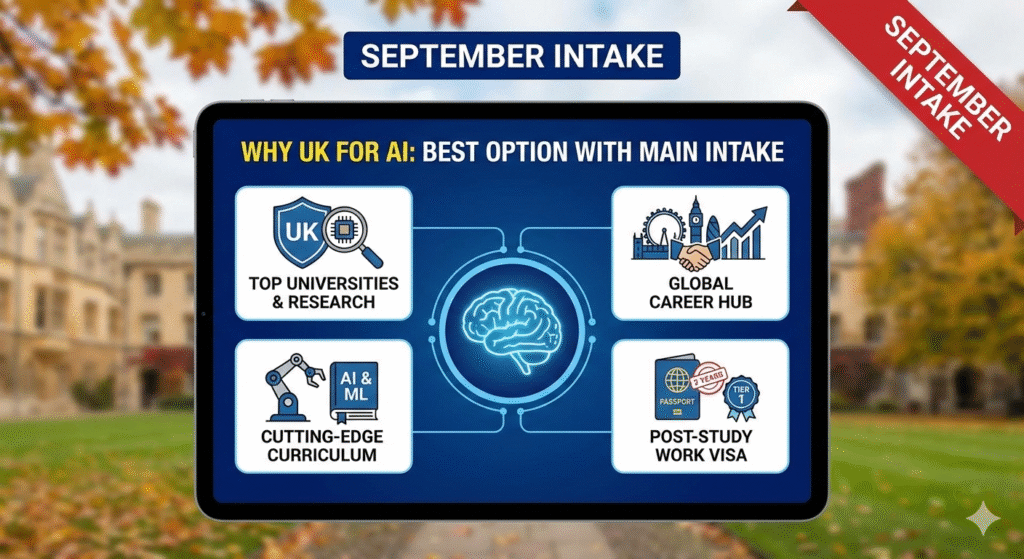

Indian students who are serious about Artificial Intelligence or related fields in the UK keep coming back to the same question every year: September or January? Both intakes are there, and January has its place, but September is still the clear favourite for 2026 and honestly, it’s not even close for most people. As education consultants who sit with Indian applicants talking about AI degrees all the time, we see September giving the biggest advantages in course options, job timing, funding, campus life, and just fitting naturally with how things work in India. Here’s why the main intake keeps coming out on top for AI/ML programs.
You Get the Full Menu of AI Courses No Settling Needed
September is when almost every UK university opens everything. You have access to the complete range: MSc Artificial Intelligence, AI & Machine Learning, Data Science & AI, Robotics & AI, AI for Business, Ethical AI, Computer Vision, Natural Language Processing, and all kinds of specialised streams.
The top places, Imperial College London, University of Edinburgh, UCL, Manchester, King’s College London, Southampton, Bristol, and many more, run their flagship AI programs in September. January is usually a lot narrower, fewer universities offer it, specialisations are limited, and often you only get the secondary or leftover courses.
If you want the exact AI program that matches your background (pure technical AI, AI ethics, applied AI in healthcare or finance, or industry-focused AI), September gives you real choice. January makes you compromise or switch plans.
Perfect Timing for AI Jobs and Graduate Recruitment
September-start AI master’s programs typically finish around June-July the next year. That lines up right in the middle of the UK’s main graduate recruitment season, summer is when tech giants, consulting firms, AI startups, banks, automotive companies, and research labs hire fresh master’s graduates in AI and machine learning.
Career services are at full speed, on-campus AI-specific recruitment events are frequent, and companies target the big September cohort. You graduate exactly when hiring windows are wide open.
January starters often finish in December-January, missing that summer wave. Fewer AI graduate schemes are available, job starts get delayed, or you end up waiting another full cycle.
For Indian students who want to make the most of employability in AI and use the two-year Graduate Route visa properly, September timing is hard to beat.
Biggest Scholarships and Funding Pools
The largest scholarships for AI-related fields, GREAT Scholarships for Indians, Commonwealth Scholarships, Chevening, university-specific merit awards, industry-sponsored funding (Google, DeepMind, IBM, etc.) are almost always linked to the September intake. Funding pots are biggest, competition is spread across more people, and early applications (December 2025-March 2026 deadlines) get first access.
January intakes usually have much smaller dedicated scholarship budgetsm or none at all for many programs. You miss the main funding opportunities.
Indian students who are counting on partial or full fee waivers find September offers far more realistic chances to cut costs significantly.
Full Campus Life, Networking, and Integration from Day One
September is when universities roll out their biggest freshers’ weeks, welcome events, orientation programs, AI society fairs, hackathons, and career fairs. You join the largest cohort of the year more international students, more Indian peers, more chances to make friends, form study groups, and build professional networks from the very first week.
AI and machine learning thrive on connections, group projects, hackathons, alumni events, industry talks all peak in the main intake. The international mix (and Indian community) is strongest in September.
January starters join mid-cycle, smaller groups, quieter start, and you sometimes miss the early momentum and integration activities that help you settle and succeed faster.
For Indian students adjusting to UK life, September gives the fullest, most supported welcome.
Natural Fit with Indian Academic and Work Cycles
Most Indian students finish undergrad or final-year exams in May-June. The September intake offers a non-obligatory summer break, results announced, little rest, early 2026 application, and a September start, no long gaps, no loss of momentum. January entails having everything done much earlier (deadlines are often late the previous year), and this can be rushed if results, IELTS, or other documents are late.
September also coincides with a lot of Indian company recruiting cycles. So, if you are intending to come back with the UK AI experience after your degree, then this is good news for you.
Final Thoughts: September or January for AI Courses in UK?
January can be an option if you require more time or have missed the September deadlines, but for most Indian students in 2026, September is the better choice, the largest program selection, most favorable recruitment timing, biggest funding opportunities, most complete campus experience, and the entire timeline is smoother.
If you’re serious then opt for best Artificial intelligence courses in UK or pure AI/ML, choose September intake 2026 in UK before deadline, many top programs have rolling deadlines or close by spring 2026.
Always check each university’s official website for exact dates, entry requirements, and course availability, some AI programs only run in September. September just gives you the fullest, most supported path to a strong UK AI degree.
Another Practical Layer Indian Students Frequently Neglect
The last factor September still reigns supreme over AI courses is the way it promotes long-term academic growth and research avenues. Most Indian students begin with a master’s degree in artificial intelligence or AI and machine learning but eventually seek a Ph.D. study, an industrial research career, or a funded research assistantship in the UK or Europe. September intakes facilitate this transition since November to March, the time when most research assistantship, doctoral training centres, and funded PhD calls are opened, overlaps with the period when September-intake students are already settled, networking with faculty, and academically performing well. PhD supervisors usually pick their candidates from the larger September cohorts they have been teaching for an entire academic year. In contrast, January starters often arrive too late to build those connections for the main research funding cycle. For students who see AI not only as a taught degree but also as a long-term career in research, innovation, or deep-tech leadership, September provides continuity: greater academic visibility, easier access to supervisors, and matching with UK research timelines. This nuance can be seen as a minor but significantly impactful factor that fortifies the reason for the September intake being the most strategically sound one for serious AI aspirants from India.
read more blog on trackcourier.xyz