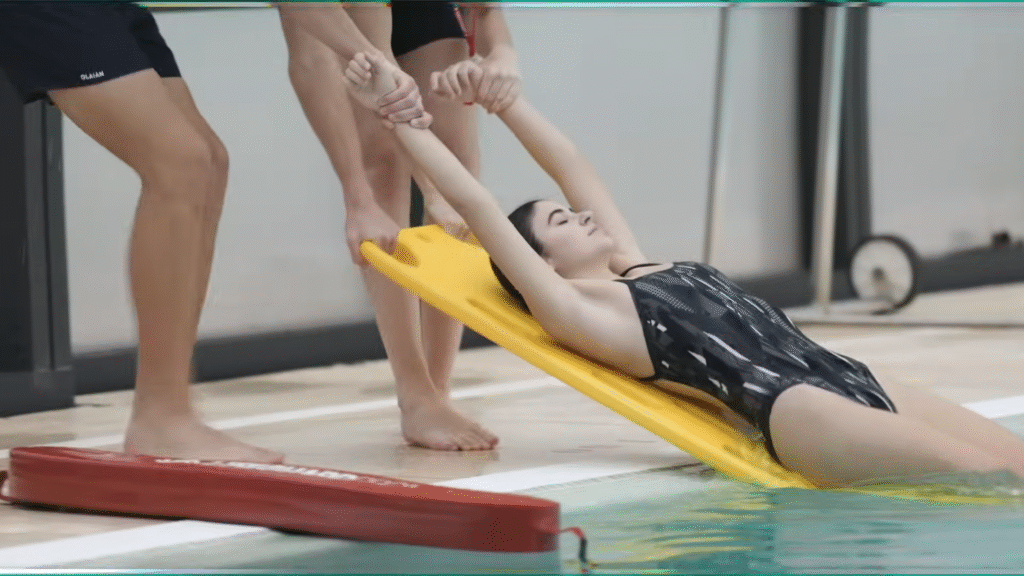

A lifeguard is a trained safety professional who helps prevent emergencies around water and responds quickly when something goes wrong. That includes:
- Scanning and spotting distress early
- Enforcing safety rules to prevent accidents
- Performing water rescues
- Providing CPR/AED and First Aid care until EMS arrives
Lifeguarding isn’t just about being a strong swimmer—it’s about prevention, vigilance, and emergency response skills practiced to a standard.
Who Needs Lifeguard Training and Who Is It For?
Lifeguard training is typically for:
- Teens and adults who want a job at a pool, waterpark, beach, lake, or aquatic center
- Current lifeguards who need recertification
- Employers who want staff trained to a consistent program
ALA lifeguard training states its training supports lifeguards working in many environments (pools, lakes, rivers—anywhere people swim).
What Does Lifeguard Training Include?
Most lifeguard programs cover three core areas:
- Rescue skills (in-water + land response)
- CPR/AED for breathing and cardiac emergencies
- First Aid for injuries and sudden illness
ALA’s lifeguard certification program specifically includes Lifeguarding + CPR/AED + First Aid.
What Are the Requirements to Start Lifeguard Training?
Requirements can vary by certification type and facility, but commonly include:
- Minimum age (often 15+)
- Comfort in the water and ability to complete swim skills tests
- Ability to follow instructions, practice scenarios, and pass skills evaluations
ALA describes two pathways—shallow water and deep water—with different swimming prerequisites (for example, deep water includes a longer continuous swim and a timed weight-retrieval event).
Who Should Choose Shallow Water vs Deep Water Lifeguard Certification?
Shallow Water Lifeguard
Best for people who can swim but aren’t ready for deep-water endurance requirements. ALA notes shallow water certification is designed for those who can swim at least 100 yards and work in shallow-water environments.
Deep Water Lifeguard
Best for people aiming to work at deeper pools or more demanding aquatic venues. ALA describes deeper-water requirements like a longer continuous swim and a timed submerged weight retrieval.
If you’re not sure which you need, the simplest answer is: ask the facility where you want to work what they accept and what environment you’ll guard.
How Does Lifeguard Training Work?
Most programs follow a simple structure:
- Learn the knowledge (rules, scanning, victim recognition, emergency steps)
- Practice skills (entries, approaches, carries, extrication, spinal management)
- Test and demonstrate competence (written + practical skills)
ALA offers training that can be completed online and/or in person depending on the option, including national certification pathways.
How Does Online Lifeguard Training Work (and Is It Legit)?
Online lifeguard training usually means blended learning: you complete the “classroom/theory” portion online, and then demonstrate physical rescue skills in water through required evaluations.
ALA describes its lifeguard online certification as a blended course with video instruction and online study materials, with employer involvement in skills assessment and ongoing practice.
A helpful way to evaluate legitimacy (for any provider):
- Is there a skills verification component?
- Is the certification recognized/accepted where you plan to work?
- Does it align to widely used safety guidance for aquatic venues?
The CDC’s Model Aquatic Health Code (MAHC) is widely referenced guidance for safer aquatic operations and includes topics like lifeguard training and certification.
What Does “Lifeguard Training Near Me” Mean (and How Do You Find the Right One)?
When people search “lifeguard training near me,” they usually mean one of these:
- A class in their state/city with scheduled sessions
- A training option they can complete fast, with skills evaluation arranged locally
- A certification that local employers actually accept
ALA states it offers lifeguard training nationwide and directs learners to select their state to find relevant options.
People-first tip: Before you pay for any course, message the pool/beach/waterpark where you want to apply and ask:
- “Which lifeguard certifications do you accept?”
- “Do you require deep-water certification?”
That one step can save you time and money.
How Long Is Lifeguard Certification Valid?
ALA states that its Lifeguard, CPR/AED, and First Aid certifications are valid for two years.
(Always confirm with your employer and local rules if your facility has stricter internal policies.)
Who Needs Lifeguard Recertification and How Does It Work?
If your certification is expiring (or already expired), you’ll typically take a recertification/refresher program that focuses on:
- Updated emergency response steps
- Re-testing critical rescue skills
- CPR/AED + First Aid refresh
ALA offers a lifeguard recertification program covering Lifeguarding, CPR/AED, First Aid, and additional safety topics depending on the recert option.
How to Choose the Best Lifeguard Training Program for Your Goals
Choose based on where you want to work:
- Pool lifeguard: focus on deep-water eligibility if your pool has deep areas
- Waterpark lifeguard: look for training that matches higher bather loads and features
- Beach/open water: prioritize open-water readiness (waves, currents, long-distance scanning)
ALA describes specialized training options for different lifeguard environments (beach, pool, waterpark).
What to Do After You Get Certified
Once certified, your success as a lifeguard depends on continuing practice—not just passing a course.
ALA emphasizes the importance of facility orientation so lifeguards understand the specific operation, responsibilities, and expectations at their workplace.
A smart “first week” checklist:
- Learn emergency action plans and radio/whistle signals
- Walk your zone (blind spots, entries/exits, rescue equipment locations)
- Practice your facility’s most common scenarios
- Attend in-service practice whenever offered
Also Read About for more information: click here.
FAQs
What is lifeguard training?
Lifeguard training teaches you how to prevent aquatic emergencies, perform rescues, and provide CPR/AED and First Aid care until EMS takes over.
Who can take lifeguard training?
Most programs allow teens and adults who meet age and swim-skill prerequisites. Some certifications offer shallow-water options for people who aren’t ready for deep-water requirements.
How long does lifeguard training take?
It depends on the program format (in-person, blended, self-paced online). ALA notes its program is self-paced and many finish in a few days, with overall training time described at about 27.5 hours.
Can I do lifeguard training online?
Yes—many providers use blended learning (online learning + in-water skills verification). ALA offers online lifeguard training with video instruction and online study materials, alongside skill assessment expectations.