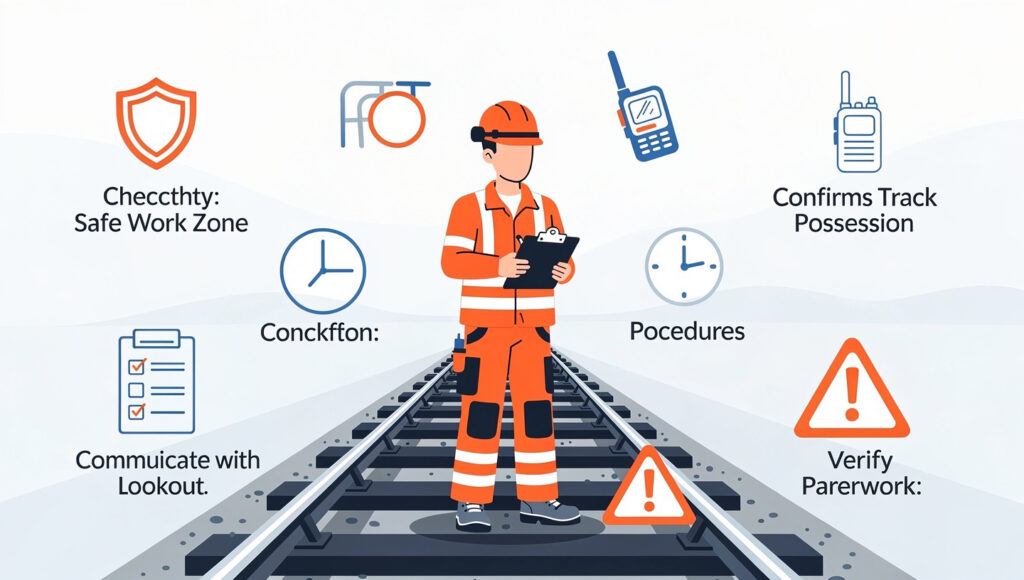

Working near or on the railway network comes with serious legal and safety obligations. A PTS-certified worker carries a defined set of responsibilities that go far beyond simply holding a card—they protect themselves, their colleagues, and the public every time they step into a rail environment.
Whether you are preparing to enroll in a PTS training course in London or you already hold your certification, understanding exactly what responsibilities come with the role helps you perform your duties with confidence and keep every worksite compliant.
1. What Is PTS Certification?
Personal Track Safety (PTS) certification is the baseline safety qualification required for anyone who needs to access the operational railway in the United Kingdom. Network Rail and its contractors require all workers — from civil engineers to vegetation clearance operatives — to hold a valid PTS card before they set foot in any controlled track zone.
Completing a recognised pts training course london equips workers with the knowledge they need to identify hazards, understand protection arrangements, and respond correctly when something goes wrong. The certification is not a formality; it is a legal prerequisite that reflects a worker’s proven understanding of live rail dangers.
Who Needs PTS Certification?
- Track workers, maintenance crews, and inspection staff
- Engineers, surveyors, and site managers working near the railway
- Vegetation, drainage, and earthworks operatives
- Any contracted staff whose work brings them within the controlled zone
2. Core Responsibilities of a PTS-Certified Worker
Holding a PTS card means you accept accountability for a wide range of on-site behaviours. These responsibilities are not optional — they form the conditions under which the certification is granted and maintained.
01 — Comply With Protection Arrangements Workers must only enter a track zone when a formally established protection arrangement — such as a lookout-operated or possession-based system — is in place and confirmed.
02 — Follow Briefings Before Every Shift Attending and actively listening to the site safety briefing before each worksite entry is a mandatory duty, not a suggestion.
03 — Report Hazards Immediately A PTS worker must report any unexpected hazard, near-miss, or change in track conditions to the Responsible Manager without delay.
04 — Maintain Fitness for Duty Workers must declare when they are unfit to work — whether due to fatigue, illness, or medication — before entering the controlled zone.
These four core duties reflect the minimum expectation. In practice, a PTS-certified worker also acts as a watchful colleague, raising awareness of risks that affect the whole team — not only themselves.
3. Key Safety Rules PTS Workers Must Follow
Network Rail’s Rule Book and associated standards set out the detailed safety rules that every PTS card holder must observe. Graduates of a pts training course london cover these rules in depth during their assessment, and understanding them forms the foundation of safe on-track work.
“A PTS-certified worker must never assume a line is safe — they must confirm it through the correct protection arrangement every single time.”
Line Blockage and Possession Rules
Workers must understand the difference between a line blockage, a possession, and a lookout warning system. They must only work within the limits of the protection in place and must never stray outside those boundaries without authorisation.
Lookout and Warning Systems
When a lookout system is in operation, the PTS worker must know the agreed warning signal, understand the defined place of safety, and be capable of reaching it in time. This knowledge is a core part of any quality pts training course london curriculum and must remain sharp throughout a worker’s career.
Speed and Clearance Awareness
Workers must be aware of train speeds on the lines they work near, maintain correct clearance distances from the running rail, and understand how dynamic movement — such as bending down or carrying equipment — affects their working envelope.
4. On-Track Safety: What Workers Must Do Every Day
Day-to-day responsibilities for a PTS card holder extend across the full duration of every shift. Compliance does not stop after the morning briefing — it runs continuously from site entry to site exit.
Daily On-Track Duties:
- Confirm the protection arrangement is active before crossing the yellow line
- Maintain awareness of your position relative to the running rail at all times
- Communicate clearly with your Lookout or Responsible Manager if conditions change
- Ensure all tools and equipment remain clear of the track gauge
- Stand down and move to a place of safety when instructed — without hesitation
- Document and report any incident or near-miss before leaving the site
These duties apply equally whether a worker is a seasoned contractor or someone who completed their very first pts training course london last week. Experience does not reduce obligation — it deepens it.
5. PPE and Equipment Responsibilities
Every PTS-certified worker carries personal responsibility for their protective equipment. Wearing the correct PPE is not simply a site rule — it is a condition of safe working and a requirement under the Health and Safety at Work Act 1974.
Standard PPE requirements for on-track workers typically include high-visibility clothing to the correct EN ISO standard, safety footwear rated for the work environment, a hard hat where overhead risk is present, and hearing protection in high-noise areas. Workers must inspect their PPE before each shift, replace damaged items immediately, and never enter the controlled zone without the correct standard of protection in place.
Beyond personal equipment, PTS workers share responsibility for keeping the worksite tidy and hazard-free. Tools left on or near the track, waste materials, and improperly stored equipment all create risks that affect the entire team.
6. Renewal and Ongoing Competence
A PTS card is valid for three years from the date of issue. As that expiry date approaches, the card holder must complete renewal training and re-assessment to demonstrate that their knowledge remains current and accurate. Letting a card lapse disqualifies a worker from entering the controlled zone until renewal is complete.
Renewal is not simply a repeat of the original process — it is an opportunity to refresh knowledge of any rule changes issued by Network Rail and to re-examine scenarios that may have evolved since initial certification. Many workers choose to complete their renewal via a pts training course london provider, particularly if they work on projects based in or near the capital.
“Renewal is not paperwork — it is a professional commitment to staying as safe and capable on day 1,000 as on day one.”
Employers have a duty to track the expiry dates of all PTS cards held by their workforce and to arrange renewal well in advance of the deadline. Workers, in turn, carry personal responsibility for being aware of their own card status and raising it with their employer promptly.
7. Common Questions About PTS Duties
Can a PTS worker refuse to enter a zone they consider unsafe?
Yes. Every PTS-certified worker has both the right and the responsibility to refuse entry into a controlled zone if they believe the protection arrangement is inadequate or if conditions have changed in a way that creates unacceptable risk. Raising a safety concern is never a disciplinary matter — it is exactly what the certification trains workers to do.
Does PTS certification cover all types of railway work?
PTS certification grants access to the controlled track zone but does not authorise specialised tasks such as working on live electrified infrastructure or operating railway plant. Those activities require additional role-specific training on top of the base PTS qualification.
What happens if a PTS worker breaks a safety rule on site?
A safety breach can lead to immediate removal from the worksite, suspension of the PTS card, and formal investigation by the Principal Contractor and Network Rail. In serious cases, criminal proceedings under health and safety legislation may follow. The responsibilities a worker accepts when they complete a pts training course london carry real legal weight.
Is PTS training the same across all providers?
The core syllabus is set by Network Rail and is consistent across accredited providers. However, the quality of teaching, the depth of scenario practice, and the support offered to learners can vary significantly. Choosing a provider with a strong track record in delivering the pts training course london ensures workers leave with knowledge they can apply confidently, not simply a card to tick a compliance box.
Key Takeaways
PTS certification is not the end of a safety journey — it is the starting point. A PTS-certified worker accepts ongoing responsibility for their own safety, the safety of colleagues, and the integrity of every worksite they enter. They follow protection arrangements without exception, report hazards without hesitation, maintain their PPE to the required standard, and renew their knowledge every three years.
Understanding these responsibilities in full — before stepping onto the track for the first time — is precisely what a high-quality pts training course london prepares workers to do. The railway environment rewards preparation and punishes complacency. Workers who take their PTS responsibilities seriously protect not only themselves but every person on and around the network.