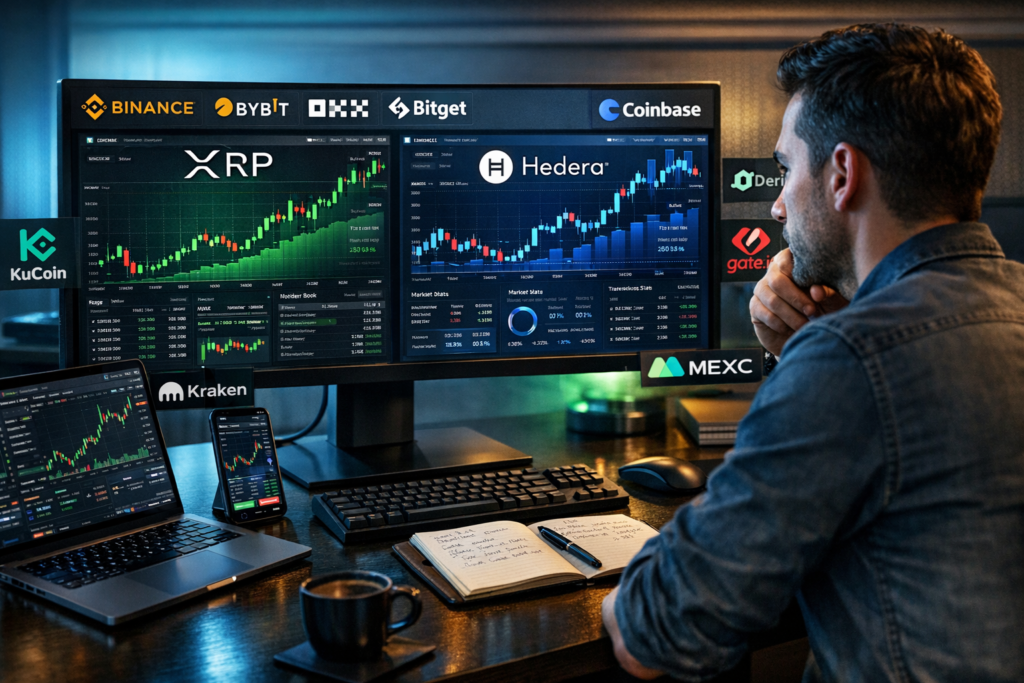

Cryptocurrency investors are always searching for the next big opportunity. Two digital assets that frequently come up in discussions are Hedera (HBAR) and XRP. Both projects focus on fast transactions, enterprise adoption, and real-world use cases, but they approach blockchain technology differently.
In this detailed guide, we will explore HBAR vs XRP, including their technology, use cases, price predictions for 2026, and how investors can exchange XRP to HBAR.
What is Hedera (HBAR)?
Hedera (HBAR) is the native cryptocurrency of the Hedera Hashgraph network. Unlike traditional blockchains, Hedera uses a unique consensus mechanism called Hashgraph, which provides high throughput, low fees, and strong security.
The Hedera network was designed primarily for enterprise applications, making it attractive to large companies and institutions.
Key Features of HBAR
1. Hashgraph Technology
Instead of using traditional blockchain blocks, Hedera uses a directed acyclic graph (DAG) structure called Hashgraph. This allows faster transaction processing and lower latency.
2. High Scalability
Hedera can process thousands of transactions per second, making it suitable for large-scale applications such as supply chains and digital identity systems.
3. Enterprise Governance
Hedera is governed by a council of major corporations including global technology and financial companies.
4. Low Transaction Fees
HBAR transactions are extremely cheap, usually fractions of a cent, making the network efficient for micropayments.
What is XRP?
XRP is the native token of the XRP Ledger, developed by Ripple Labs.
The primary goal of XRP is to enable fast and low-cost cross-border payments, particularly for banks and financial institutions.
Key Features of XRP
1. Fast Payment Settlement
XRP transactions settle in just a few seconds, which is significantly faster than traditional banking systems.
2. Financial Institution Adoption
Ripple has partnered with banks and payment providers worldwide to facilitate cross-border transfers.
3. Extremely Low Fees
Transactions on the XRP Ledger cost a tiny fraction of XRP (about 0.00001 XRP).
4. Strong Liquidity
Because XRP is one of the largest cryptocurrencies by market cap, it has strong liquidity across exchanges.
HBAR vs XRP: Key Differences
Although both projects target enterprise adoption, their design philosophies differ significantly.
| Feature | HBAR | XRP |
|---|---|---|
| Technology | Hashgraph (DAG) | Blockchain |
| Primary Use | Enterprise apps, smart contracts | Cross-border payments |
| Speed | Very high throughput | Fast settlement |
| Governance | Hedera Council | Ripple ecosystem |
| Market Cap | Smaller | Much larger |
XRP is currently one of the largest cryptocurrencies by market cap, while HBAR is significantly smaller.
This difference plays a major role in investment potential.
Technology Comparison: Hedera vs XRP
Hedera Network
The Hedera network focuses on multiple enterprise use cases:
- Tokenization
- Digital identity
- Supply chain tracking
- DeFi and NFTs
- Asset management
Research comparing blockchain systems found that Hedera can offer very low latency and minimal metadata leakage compared to other ledgers.
XRP Ledger
The XRP Ledger specializes in:
- Cross-border payments
- Banking infrastructure
- Liquidity for remittances
- Financial institution integration
Its architecture provides stable transaction fees and predictable performance for financial institutions.
HBAR vs XRP Market Cap Comparison
Market capitalization is one of the biggest differences between the two projects. HBAR vs XRP Market Cap Comparison
XRP’s market cap is many times larger than HBAR, meaning:
- XRP is more established
- HBAR potentially has more room for growth
For example, XRP’s market cap has historically been over 20 times larger than HBAR.
This suggests that HBAR could deliver higher percentage gains if adoption grows.
HBAR vs XRP Use Cases
HBAR Use Cases
- Enterprise blockchain infrastructure
- Tokenized assets
- Decentralized identity systems
- Supply chain monitoring
- Carbon credit markets
HBAR is designed to power applications across many industries.
XRP Use Cases
- International money transfers
- Banking settlements
- Liquidity for payment providers
- Remittance networks
XRP focuses heavily on financial payments and banking integration.
HBAR vs XRP Price Prediction for 2026
Price predictions are speculative, but analysts often estimate possible ranges based on adoption trends.
HBAR Price Prediction 2026
Some analysts estimate HBAR could reach $0.63 to $0.93 by 2026, depending on adoption and ecosystem growth.
More optimistic projections suggest that if HBAR reached XRP’s current market cap, its price could exceed $4 per token.
XRP Price Prediction 2026
Some forecasts suggest XRP could potentially reach $10–$15 by 2026 if institutional adoption continues and regulatory issues remain favorable.
However, because XRP already has a large market cap, its percentage growth may be smaller compared to newer projects.
Community and Investor Sentiment
Cryptocurrency communities often debate whether HBAR or XRP has better long-term potential.
Some investors believe HBAR could deliver stronger ROI because of its smaller market cap and broader use cases.
For example, one Reddit user wrote:
“Both solid plays… XRP maybe a 10x, HBAR may do 15x.”
While opinions vary, many investors choose to hold both assets for diversification.
Which is the Better Investment for 2026?
The answer depends on your investment strategy.
Choose HBAR If You Want
- Higher potential upside
- Exposure to enterprise blockchain technology
- Investment in a newer ecosystem
Choose XRP If You Want
- A more established cryptocurrency
- Strong liquidity
- Adoption in financial institutions
Many long-term investors consider holding both tokens as a balanced strategy.
How to Exchange XRP to HBAR
If you already hold XRP and want to diversify into HBAR, you can easily convert it on most cryptocurrency exchanges.
Step-by-Step Guide
Step 1: Choose a Crypto Exchange
Select an exchange that supports both XRP and HBAR trading pairs.
Step 2: Deposit XRP
Transfer your XRP to the exchange wallet.
Step 3: Find the XRP/HBAR Pair
Search for the trading pair or convert XRP to USDT first.
Step 4: Execute the Trade
Swap XRP for HBAR using a market or limit order.
Step 5: Withdraw to a Wallet
For better security, store HBAR in a crypto wallet instead of leaving it on the exchange.
Risks of Investing in HBAR and XRP
Before investing, consider these risks.
1. Market Volatility
Cryptocurrencies can experience extreme price swings.
2. Regulatory Uncertainty
Government regulations may affect crypto markets.
3. Competition
Both projects face competition from other blockchains and payment networks.
4. Adoption Risk
Future price growth depends heavily on real-world adoption.
The Future of Hedera and XRP
Both Hedera and XRP are focused on enterprise adoption, which could drive long-term growth.
Key trends that may influence their future include:
- Institutional blockchain adoption
- Central bank digital currencies (CBDCs)
- Tokenization of real-world assets
- Cross-border payment modernization
As blockchain technology evolves, both networks may continue expanding their ecosystems.
Final Thoughts: HBAR vs XRP in 2026
The HBAR vs XRP debate highlights two powerful but different crypto projects.
- XRP dominates in global payments and financial infrastructure.
- HBAR focuses on enterprise applications and scalable distributed ledger technology.
If adoption continues growing, both cryptocurrencies could play major roles in the future digital economy.
For investors looking toward 2026, the best strategy may be diversification—holding both assets to benefit from different sectors of the blockchain industry. How to Transfer Crypto Between Exchanges