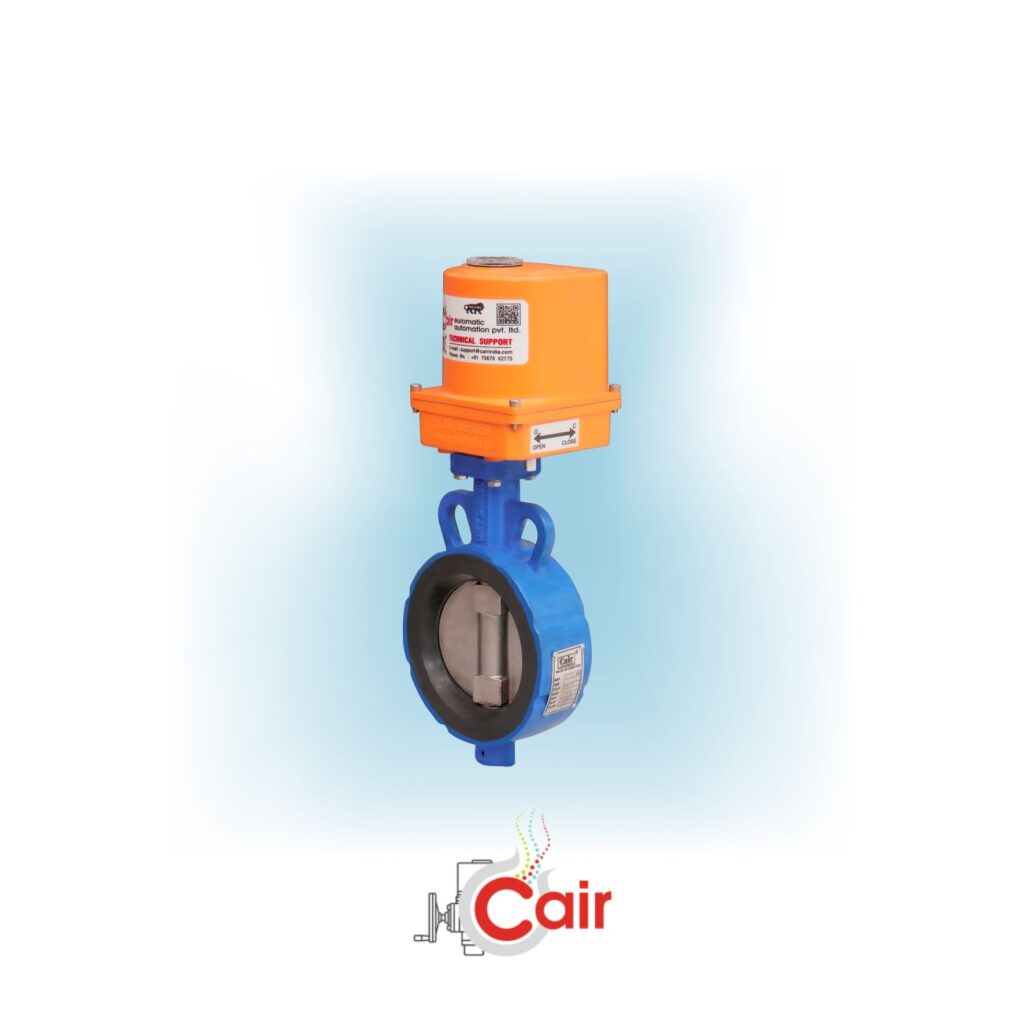

In modern industrial systems, automation is no longer a luxury — it is a necessity. Industries require precise flow control, remote operation, and improved safety standards. One of the most important components that makes this possible in a motorized butterfly valve is the electric actuator.
The electric actuator transforms a simple butterfly valve into a smart, automated flow control solution. It allows industries to open, close, or regulate flow without manual effort. This article explains the working, types, safety features, integration, and technical specifications of motorized butterfly valves equipped with electric actuators.
What is an Electric Actuator?
An electric actuator is a motor-driven device that converts electrical energy into mechanical motion. In a motorized butterfly valve, the actuator rotates the valve shaft to control the disc position.
Instead of using a hand lever or gearbox, the actuator receives an electrical signal from a control panel or automation system. It then rotates the valve disc to the required position — fully open, fully closed, or partially open.
This automation improves efficiency, reduces manpower, and ensures precise flow regulation.
How the Electric Actuator Works in a Butterfly Valve
The operation process is simple and reliable:
- The control panel or PLC sends an electrical signal.
- The actuator motor activates.
- The motor rotates internal gears.
- The shaft turns the butterfly valve disc.
- Limit switches stop the movement at the preset position.
Because butterfly valves operate on a quarter-turn (90°) mechanism, the actuator only needs to rotate the disc from 0° to 90° for full operation.
This quick movement ensures fast response and accurate flow control.
Types of Actuator Operation
Electric actuators in motorized butterfly valves are generally available in two main types:
1. On/Off Operation
This is the most common type.
- Valve is either fully open or fully closed.
- Used in systems where only isolation is required.
- Ideal for water supply lines, drainage systems, and basic industrial pipelines.
- Simple wiring and easy control.
On/Off actuators are cost-effective and suitable for applications that do not require flow regulation.
2. Modulating Operation
Modulating actuators allow partial opening and closing of the valve.
- Valve position can be adjusted between 0% and 100%.
- Used for precise flow control.
- Compatible with 4–20 mA or 0–10V signals.
- Ideal for chemical processing, HVAC systems, and automated plants.
Modulating actuators provide greater control and are widely used in advanced industrial automation systems.
Safety Features of Electric Actuators
Safety is extremely important in industrial automation. Modern electric actuators include several built-in safety features to protect both equipment and operators.
Thermal Overload Protection
- Protects the motor from overheating.
- Automatically cuts off power if temperature exceeds safe limits.
- Prevents motor damage.
- Extends actuator lifespan.
This feature is especially important in high-duty-cycle applications.
Manual Override
- Allows manual operation during power failure.
- Useful for emergency situations.
- Ensures system reliability.
- Provides operational flexibility.
Manual override ensures that the valve can still function even if there is an electrical issue.
Additional Safety Features May Include:
- IP-rated weatherproof enclosure
- Torque overload protection
- Position indicators
- Limit switches
- Anti-condensation heaters (for outdoor use)
These features improve durability and safe operation in harsh industrial environments.
Integration with Control Panels
One of the biggest advantages of motorized butterfly valves with electric actuators is easy integration with control systems.
Electric actuators can be connected to:
- Local control panels
- PLC systems
- SCADA systems
- DCS automation systems
Control Panel Capabilities Include:
- Local and remote operation
- Open/Close push buttons
- Indicator lamps (Open/Close/Fault)
- Emergency stop button
- Overload protection
- Feedback signal to control room
This integration allows centralized monitoring and precise system management.
Technical Specifications of Motorized Butterfly Valve
To ensure reliable performance, motorized butterfly valves are available in the following specifications:
Size
1-1/2” TO 72”
The wide size range makes these valves suitable for:
- Small process pipelines
- Municipal water lines
- Large industrial installations
Custom sizes are available as per requirement, depending on project needs.
Material of Construction (MOC)
Available materials include:
- CI (Cast Iron) – Suitable for general water applications
- DI (Ductile Iron) – Stronger and more durable
- WCB (Carbon Steel) – Suitable for higher pressure applications
- CF8 (Stainless Steel 304) – Excellent corrosion resistance
Material selection depends on fluid type, pressure, and environmental conditions.
Seals
Different sealing materials are available for leak-proof performance:
- Nitrile (NBR) – Suitable for oil and water
- EPDM – Ideal for water and mild chemicals
- Viton – Best for chemical and higher temperature applications
Proper seal selection ensures long service life and reliable sealing.
Pressure Rating
Available pressure classes:
PN 6 / PN 10 / PN 16 / PN 20 / PN 25
Selecting the correct pressure rating ensures safe operation under system load.
Temperature Range
–20°C to 80°C (Depending on MOC and Seal)
The temperature range varies based on material and sealing selection.
End Connection
Wafer Type
Wafer-type design offers:
- Compact installation
- Lightweight construction
- Cost-effective setup
- Easy maintenance
It is widely used in industrial and municipal pipeline systems.
Why Electric Actuators Are Essential in Modern Industry
Industries today demand:
- Remote operation
- Reduced manpower
- Fast response
- Improved safety
- Precise control
Electric actuators provide all these benefits. They transform a simple butterfly valve into a smart automation device that enhances overall plant efficiency.
Conclusion
The electric actuator is the heart of a motorized butterfly valve. It converts electrical signals into precise mechanical movement, enabling automated and reliable flow control.
With options like On/Off and Modulating operation, built-in safety features such as thermal overload protection and manual override, and seamless integration with control panels, electric actuators offer complete automation solutions.
Combined with robust specifications — sizes from 1-1/2” to 72”, materials like CI, DI, WCB, CF8, sealing options including Nitrile, EPDM, Viton, pressure ratings up to PN 25, temperature range of –20°C to 80°C, and Wafer Type ends — motorized butterfly valves are designed to meet diverse industrial requirements.
Available as per requirement, these valves provide reliable, safe, and efficient performance in modern automated systems.